
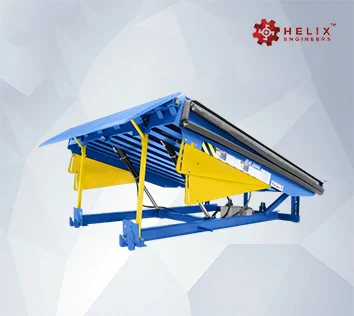
Dock Leveller
A Dock Leveller is a permanent loading dock installation engineered to bridge the physical gap and height differential between a facility’s concrete loading bay floor and the bed of a transport truck or trailer. Acting as a heavy-duty transition ramp, this equipment compensates for varying truck bed heights, enabling forklifts, pallet trucks, and personnel to move goods directly in and out of trailers safely and efficiently.
Available in hydraulic, mechanical (spring-assisted), and air-powered configurations—with hinged (flip-lip) or telescopic (telescoping lip) extensions—Dock Levellers flex dynamically under cross-dock traffic to accommodate vehicle suspension floating during loading and unloading operations.
Purpose and Application
Dock Levellers streamline warehouse logistics by transforming separate dock and vehicle structures into a single continuous, load-bearing pathway.
Key Applications:
- Distribution Centers & Logistics Hubs:Enable high-speed loading and unloading of commercial box trucks, trailers, and shipping containers.
- Manufacturing Facilities:Receive incoming raw bulk materials and dispatch finished products directly from production staging areas.
- Cold Storage & Food Logistics:Maintain thermal seals when integrated with sectional dock doors and inflatable dock shelters to minimize energy loss.
- E-Commerce Fulfilment Centers:Handle intense cross-docking operations with high daily vehicle turnover and varied truck bed heights.
Design and
Operation
- Reinforced Tread Plate Deck:Constructed with high-grade teardrop chequered steel deck plate supported by longitudinal steel I-beams or C-channels to prevent deck dishing under heavy forklift wheel traffic.
- Torsion-Flex Deck Construction:Allows the platform to tilt laterally up to 100 mm (4 in) to compensate for uneven truck beds during loading.
- Hydraulic Velocity Fuse Safety Stop:Emergency hydraulic check valve instantly locks the deck in place if a truck prematurely pulls away while a forklift is on the leveller, preventing free fall.
- Full-Range Toe Guards:Structural steel side plates shield foot hazards along the operating sides of the leveller deck during elevation and descent cycles.
Operational Workflow
- Vehicle Docking:The delivery trailer backs into the loading bay until firmly contacting the heavy-duty rubber dock bumpers mounted on either side of the pit frame.
- Deck Activation:The operator presses and holds the “Raise” button on the wall panel. The hydraulic cylinder elevates the deck to its maximum height position.
- Lip Deployment:Once the deck reaches peak height, the hinged lip automatically swings open (or the telescopic lip extends forward) over the rear bed of the truck.
- Bridge Alignment:The operator releases the control button. The deck and extended lip lower gently until the lip rests flat on the truck bed floor. The system is now ready for material transfer.
Production & Quality Standards
- Automated Structural Welding:Formed using CNC laser-cut steel members and robotic seam welding to guarantee long-term fatigue resistance against impact loading.
- Precision Electro-Hydraulic Assemblies:Manufactured with hard-chrome plated cylinder shafts, micro-honed barrels, and IP65-rated electric motor-pump units.
- Static & Dynamic Capacity Testing:Tested to withstand 125% of maximum rated dynamic load capacity in accordance with rigorous European and international structural engineering standards.
- Regulatory Compliance:Fully compliant with international loading dock machinery guidelines, including EN 1398, ANSI/MH30.1, and OSHA safety directives for dock equipment.
Conclusion
A Dock Leveller helps bridge the height gap between a loading dock and a truck or trailer, making the movement of goods easier and more efficient. Its strong deck, adjustable lip, and safety features support regular loading and unloading operations in warehouses, distribution centres, manufacturing units, and logistics facilities. When selecting a Dock Leveller, consider the load capacity, truck height variations, operating method, available dock space, and required safety features to find a suitable option for the facility.
Frequently Asked Questions
What is a Dock Leveller used for?
A Dock Leveller bridges the gap between a loading dock and a truck bed, allowing forklifts and pallet trucks to move goods safely during loading and unloading.
What are the different types of Dock Levellers?
Common types include hydraulic, mechanical, and air-powered Dock Levellers. The suitable type depends on the facility’s loading needs and operating conditions.
What should be considered when choosing a Dock Leveller?
Consider load capacity, truck bed height differences, platform dimensions, lip design, operating method, and safety features before choosing a Dock Leveller.